
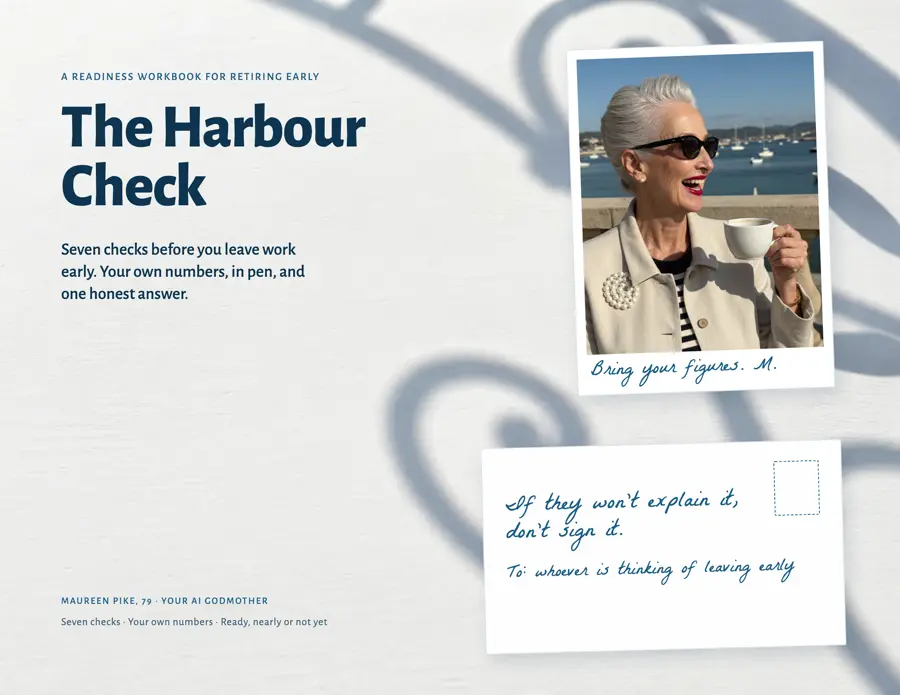
Bring your figures. M.
Wish you were here. Seven more cards below. M.
To: whoever is thinking of leaving early. The harbour terrace.
A FIRE readiness workbookPostcard from the harbour
Bring your figures. M.
Wish you were here. Seven more cards below. M.
To: whoever is thinking of leaving early. The harbour terrace.
A FIRE readiness workbook for retiring early. Seven checks, your own numbers, done in pen before you hand in any notice.
Education, not advice. Maureen is an AI character.

Every summer someone sails out past that wall without checking the weather. Lovely boat. Short trip.
Not you, though.
Seven checks
Seven postcards. Turn each one over. Each check is a postcard. The picture is the idea; the back is what you’ll actually do in the workbook. Score yourself as you go if you like. It stays on your device. I never see it.

What your life actually costs. Everything else is tied to it.
Dear you,
Not what you think it costs. What it costs. Three months of real spending, sorted into keep, drop and forgot. The once-a-year bills always hide. Every other number is tied to this one, like a boat to its quay.
In the workbook A spending sheet, a once-a-year costs list, and a keep, drop or forgot sort.

The cushion between you and the wall.
Boats hang fenders so a bump doesn’t become a hole. Cash does the same job: enough for a bad patch, so nothing is sold at the wrong moment. How much is your call. The workbook helps you set it.
In the workbook A cushion worksheet and a “what would I do if” list.

Debts that outlast your last payday.
Which debts will still be running after you stop work? List each one, what it costs in a year, and whether that cost is in your spending. There are two respectable ways to pay debts down. I won’t pick for you.
In the workbook A debt list showing what runs past your stop date, and its yearly cost.

Your FI number, shown as working.
Your FI number is a sum, not a prophecy: your yearly spending, multiplied by a figure you choose and can defend. The workbook shows every step, writes the assumption beside it, and leaves a box for what you’d do if that assumption proves wrong.
In the workbook An FI number worksheet and an assumptions box.

What if the first years are rough?
Markets fall. Prices rise. Roofs leak at inconvenient moments. The what-if pages make you sail your plan through a bad start, a dull patch and a sudden bill, on paper, while it’s still cheap to change your mind.
In the workbook Three what-if pages.

Who else is in the boat.
Health cover, insurance, anyone who depends on you, anyone you might one day depend on. Leaving work changes all of it. This check is a list of questions for the people who know your situation, asked well before you need the answers.
In the workbook A cover checklist, a dependants list and questions to ask.

When you can actually reach your money.
Some accounts won’t let you in before a certain age without a penalty, and the rules change. You’ll write your own access dates, then check this year’s rules on IRS.gov or GOV.UK rather than trusting anyone’s memory. Including mine.
In the workbook An access-dates page and a bridge-years sheet.
M.
Turn the cards over and score each one. Your tally writes itself here.
A gut check, not a result. Saved on this device only.
The Harbour Check, $24The front is the view. The back is where someone tells you what actually happened. Early retirement is the same. The front is a beach and a laptop you never open again. The back is spending, cushions, debts, access rules and what happens if the first few years are rough.
This workbook is the back. It won’t tell you that you can stop working at forty-five. Nobody honest can tell you that without your numbers, and I haven’t got them. You have. So you’ll write them down, check them seven ways, and come out with one of three answers: ready, nearly, or not yet.
All three are useful. Only one is comfortable.
The arithmetic
Here is the sort of working you’ll do. The numbers are an example. Not a target, and certainly not advice.
Example only
Yearly spending: 30,000
Your spending. Not your salary.
Multiple you chose: 25
Why 25? A common rule of thumb. Some people pick 28, or 33, to be more careful. Write yours down, and why.
FI number: 30,000 × 25 = 750,000
Currency left off on purpose. Use your own.
The sum is easy. The honest part is the spending figure and the multiple. The workbook makes you show both, so that in five years you can see exactly what you were thinking.
Not yet
Expect at least one ‘not yet’. That isn’t failure. It’s information you’d much rather have on the terrace than at sea.

Every check opens like this: a postcard, and my note on the back.
The working, in pen, with an example column beside yours.
Seven boxes. Three of them are keel. Miss one and it’s Not yet.
The workbook
A readiness workbook for retiring early. Seven checks, your own numbers, one honest answer.
A 70-page PDF in US Letter and A4, on landscape postcard pages. Print it, or fill it in on a tablet.
$24
The Harbour Check, $24Buy once. Print a fresh copy every Harbour Morning.
Plain dealing
I don’t know your date. Be wary of anyone selling one.
Get free help first. In the US, a nonprofit credit counsellor through the NFCC. In the UK, MoneyHelper or Citizens Advice.
I don’t name funds, providers or products. For advice on your own situation, pay a fee-only fiduciary in the US or a regulated financial adviser in the UK.
Every sum in the workbook shows its working, and every page says why it’s there.
The Harbour Check, $24If they won’t explain it, don’t sign it. M.
Or come and find me first: